The Next Five Years of OTT: What's Real, What's Hype, and What It Means If You're Not Netflix


Every year the streaming industry produces a fresh stack of trend reports, and every year they list roughly the same things. So rather than add another neutral list, here's something more useful: the trends we're actually seeing from inside platform development, each with a verdict on whether it deserves your roadmap, and what it means if you're a broadcaster, sports organization, or content owner rather than a global streamer.
Hybrid live + on-demand (verdict: already table stakes)
Pure VOD isn't a product anymore; it's a feature. Viewers want live immediacy and on-demand control in the same interface: sports with instant replay and full-match VOD, news with catch-up, personalized "live" channels assembled from library content.
The technical bill for this: low-latency delivery (CMAF chunked transfer has become the pragmatic standard), CDN capacity that handles event spikes, and cloud orchestration that treats live and VOD as one pipeline instead of two systems bolted together.
What it means for mid-size operators: this is the one trend on this list you can't skip. If your platform treats live as an afterthought, or worse, runs it on separate infrastructure with a separate app, you're building 2018.
The advertising renaissance (verdict: real, and bigger than most operators think)
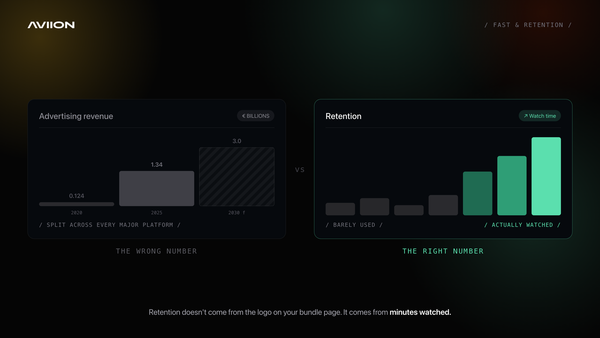
For a decade, subscription revenue was the respectable business model and ads were the fallback. Subscription fatigue ended that. The world's largest streamers all launched ad tiers, and FAST channels (free, ad-supported, linear-style) went from curiosity to a major distribution category in about four years.
The technology finally matches the ambition: server-side ad insertion (SSAI) delivers ads that survive ad blockers and look native across devices, and real-time ad decisioning brings genuine targeting to big-screen inventory. Measurement standards are maturing, which is what large advertisers were waiting for.
What it means for mid-size operators: this is the most underrated opportunity on the list. A broadcaster or rights holder with a defined audience and local advertiser relationships is structurally better positioned for FAST/AVOD than a global platform; you already sell to these advertisers. The gap has been tooling, not demand.
Deeper personalization (verdict: real, but the bar for entry is metadata, not AI)
We covered the mechanics in our first post: recommendation engines are moving from "what to watch" toward "when and how": custom live lineups, AI-assembled highlight reels, localized event versions.
The unglamorous truth from the engineering side: the platforms that win here aren't the ones with the fanciest models, they're the ones with clean, granular metadata and real-time analytics pipelines feeding those models. Personalization quality is downstream of data discipline.
What it means for mid-size operators: don't buy "AI personalization" as a checkbox. Ask what metadata standards the platform enforces at ingestion and what happens with a catalog your size on day one; that's the cold-start question. (Our first post covers what good answers sound like.)
Interactivity and social viewing (verdict: real for sports, speculative elsewhere)
Live betting integration, polls, watch parties, engagement-driven microtransactions: the "digital arena" model. For sports this is genuinely happening, because the audience is already second-screening; bringing that activity into the stream is capturing existing behavior, not inventing new behavior.
For scripted content and general entertainment, the record is much thinner. Interactive scripted experiments have been tried repeatedly at enormous cost and quietly shelved. Treat claims here with skepticism.
What it means for mid-size operators: if you're in sports, low-latency interactivity should be on your evaluation list now; it's a differentiator with a real monetization path. If you're not, this is a trend to watch, not fund.
Global reach, local execution (verdict: permanent condition, not a trend)
Streaming is borderless; rights, languages, and audience expectations are not. Territory-specific licensing, multilingual metadata, regional traffic handling, and the content-protection stack we detailed in our second post (multi-DRM, forensic watermarking, geo-enforcement) are the standing cost of operating across markets.
What it means for mid-size operators: this is actually your home-field advantage. Global platforms spend enormously to fake local nuance; you have it natively. The play is pairing local content and audience knowledge with infrastructure that handles the cross-border plumbing, which is exactly the part that makes no sense to build yourself.
The profitability reckoning (verdict: the trend that explains all the others)
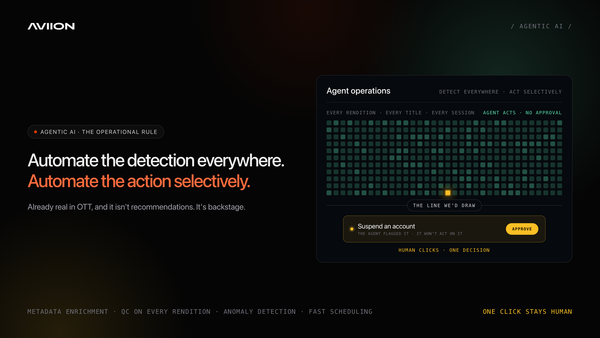
The era of growth-at-any-cost streaming ended with the market's patience for it. What replaced it: hybrid monetization (subscription + ads + transactional + commerce), disciplined content ROI, and curated offerings instead of bottomless libraries.
This is why ad tiers exist, why FAST exploded, why password-sharing became a billing event, and why "engagement" replaced "subscriber count" as the metric that matters. Every other trend on this list is partly downstream of this one.
What it means for mid-size operators: flexibility in monetization is now a platform-selection criterion. A platform that locks you into one revenue model (SVOD-only, or ads-only) is selling you 2020. You want the ability to run subscription, ad-supported, and pay-per-view on the same catalog and change the mix as your market answers back.
The honest summary
Five years out, the winners among mid-size operators won't be the ones that chased all six trends. They'll be the ones that got hybrid delivery and monetization flexibility right, invested in their metadata, and picked their battles on the rest: funding interactivity if they're in sports, leaning into FAST if they have ad relationships, and letting their platform partner absorb the infrastructure arms race.
The losers will be the ones still stuck in the old binaries (linear versus on-demand, subscription versus ads) or still trying to build all of this in-house while their audience waits.
OTT stopped being about replacing cable a while ago. It's about building a service that adapts to how your audience actually lives, watches, and pays. The next five years will decide who pulls that off, and who gets left buffering.
Your content. Your platform.
Aviion turns your content into a streaming business. Fast. Built for TV networks, sports clubs, telecoms, production houses and educators, with hybrid live/VOD delivery and flexible monetization ready out of the box. Live in weeks, owned forever.