Why FAST keeps subscribers, and why the ad money is the wrong reason to do it

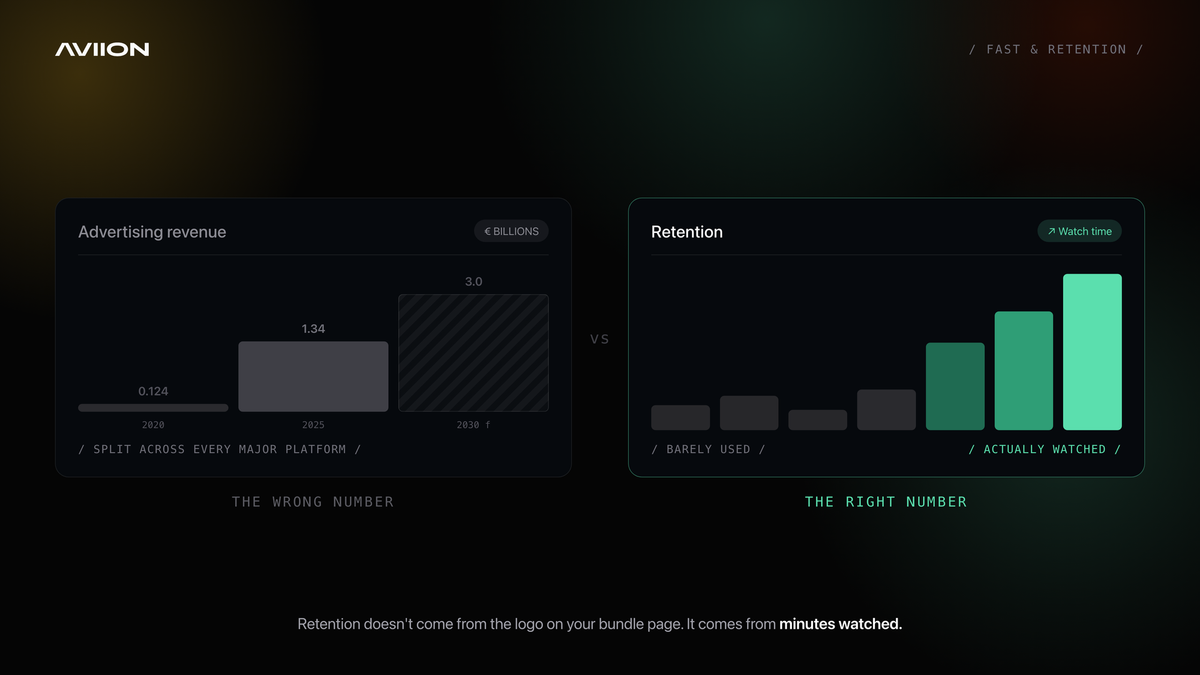
European FAST TV closed 2025 at about €1.34bn. Five years before that it was €124m. Most operators look at that number, work out what their share would be, and decide it's too small to bother with. They're right about the share. They're looking at the wrong number.
Most operators look at that number, work out what their share would be, and decide it's too small to bother with. They're right about the share. They're looking at the wrong number. Here's the breakdown.
The ad money will never be the reason
Say you have 400,000 TV households. The €1.34bn is a European figure, and it's already split between Samsung TV Plus, LG Channels, Pluto, Rakuten and the big broadcasters. Be generous with your assumptions about what you'd win. It's still small next to what you make on broadband.
So if FAST goes to your CFO as an advertising project, it dies. It should die. The revenue doesn't carry the cost of the decision. The value is on the churn line instead.
What actually stops people cancelling
You don't sell channels. You sell a household relationship, and churn decides what that relationship is worth.
TV is the part of the bundle people have opinions about. Broadband is a utility they only think about when it breaks. That's why TV in the package makes homes harder to unpick, and it's why US operators have spent real money on it. Charter and Disney did a deal in 2023 that put Disney+, Hulu and ESPN into most Spectrum TV plans, specifically to slow cancellations.
It works. But analysts went back over those bundles again in early 2026, and there's one finding that changes how you should think about all of it:
Services people barely use do very little for retention. Only the ones people actually watch make a difference.
Bundle analysis · early 2026
Retention doesn't come from the logo on your bundle page. It comes from minutes watched. That's the whole reason FAST is worth your time.
The cost difference is the point
A streaming app in your bundle costs you a fee for every subscriber, every month — including the 60% who never launch it once. A channel you run yourself is a different shape of thing entirely.
It's the cheapest way to get watch time back from a household that has quietly stopped using your TV package.
Four things you already have
Four assets, and none of them are cheap to build from scratch. That's the advantage.
Where these projects go wrong
Not the technology. The rights.
A 24/7 channel is a scheduling problem sitting on top of a rights problem. Most operator libraries are licensed for on-demand viewing, in one country, for a fixed window. Running that same content as a linear channel is often a separate right, and sometimes one nobody has ever priced.
So before anyone builds anything, someone goes through the catalogue and works out how many hours you can legally schedule. That takes a few weeks. It goes first, not third. After that, three things decide whether it works.
Test it before you launch it
Give the channels to a slice of your customers. Hold back a similar group who don't get them. Then watch three numbers over two or three billing cycles.
Ad revenue and fill rates come second. They tell you if the channel pays for itself, not whether it does the job you built it for.
One thing to sort out early: viewing data usually sits in one system and billing sits in another. If you can't connect a viewing session to a customer account, you can't prove the churn effect. And if you can't prove it, the project won't get funded a second year.
FAST is the smallest piece of this
To be upfront, FAST channels on their own aren't a strategy. They work when they sit inside one app with your live TV and your on-demand library, under your brand, connected to your billing. One guide, one search, one place people go. That's what makes the channels findable, and findable is what makes them count.
Your content. Your platform.
Aviion turns your content into a streaming business. Fast. Built for TV networks, sports clubs, telecoms, production houses and educators. Live in weeks, owned forever.