DRM, Anti-Piracy, and Data Protection: What OTT Security Actually Requires in 2026


Security is the part of an OTT platform nobody wants to talk about until it fails. Then it's the only thing anyone talks about.
The failure modes are predictable: a new release shows up on torrent sites within hours, a credential-stuffing attack turns into a churn spike, or a data-handling mistake becomes a GDPR case. Having built and operated the security stack behind streaming platforms for years, I can tell you the uncomfortable truth up front: none of these are exotic attacks. They exploit the basics - and the basics are what this post covers.
Why this is a licensing problem before it's a technical one
Here's the part that surprises operators new to the space: you often don't get to choose your security posture. Content owners choose it for you.
Major studios and sports rights holders write DRM requirements directly into licensing agreements; specific DRM systems, specific security levels, sometimes forensic watermarking as a contractual condition. No compliant DRM, no license. For premium sports rights in particular, the requirements have only tightened as live piracy has industrialized.
So the question isn't "should we invest in DRM?" It's "can we even acquire the content we want without it?" For most catalogs worth licensing, the answer is no.
The DRM layer: three systems, because that's how the market split
There is no single DRM that covers all devices. The ecosystem consolidated around three, each tied to its platform owner:
Google Widevine — Android, Chrome, and most non-Apple browsers and smart TVs. The workhorse. Note the security-level distinction: L1 (hardware-backed) is what studios typically require for HD/UHD content; L3 (software-only) often caps you at SD. This detail regularly surprises operators at certification time.
Apple FairPlay — iOS, macOS, Safari, tvOS. Non-negotiable if you have Apple users, which you do. Hardware-level protection, tightly integrated, and the only way premium content plays on Apple devices at full quality.
Microsoft PlayReady — Windows, Xbox, Edge, and a large share of smart TVs and set-top boxes. Particularly relevant for hybrid OTT/broadcast operators, where it's long been embedded in DTV workflows.
The practical consequence: multi-DRM isn't a strategy, it's the baseline. Every serious platform runs all three behind a unified license service, with the player selecting the right system per device. The real engineering work isn't choosing DRMs - it's packaging (CMAF with CENC encryption lets one set of files serve all three) and license-server logic: entitlements, concurrency limits, offline playback rules.
Anti-piracy: DRM locks the door, this watches the windows
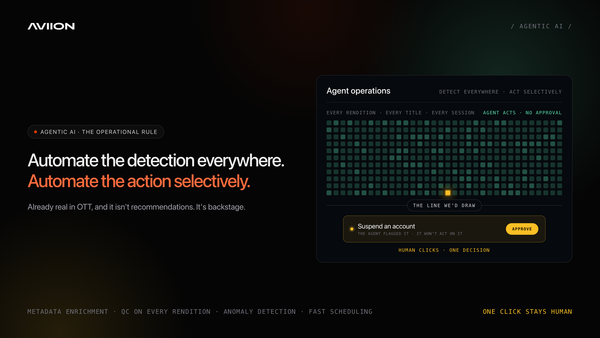
DRM stops casual copying. It does not stop a paying subscriber from restreaming your live sports feed, or a leaked screener from spreading. That's a different toolset:
Forensic watermarking embeds an invisible, per-session identifier in the video itself. When content leaks, you can trace which account or screener it came from. For live sports this has become standard practice - rights holders increasingly require it, because the value of a live stream evaporates in ninety minutes and takedowns must happen mid-match, not next week.
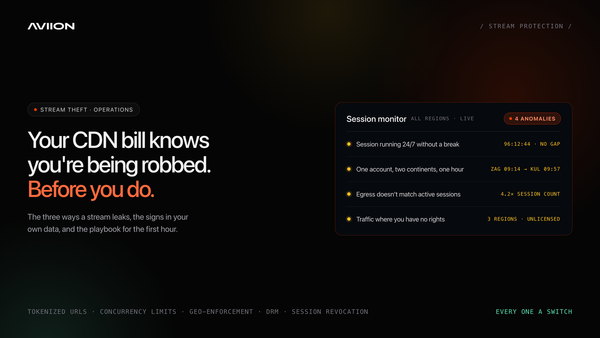
Credential-sharing and stuffing detection watches login patterns - impossible travel, concurrent streams beyond plan limits, credential lists from breached third-party sites. The interesting shift in recent years: platforms have learned that the answer to sharing isn't always a hard block. Detection feeds a business decision; upsell the household plan, step up authentication, or cut access - and the platforms that treat it commercially rather than punitively convert more sharers into payers.
CDN token authentication ensures a playback URL only works for the user and session it was issued to. Without it, your CDN quietly becomes the pirates' CDN- they hotlink your streams and you pay the bandwidth bill. This one is cheap to implement and inexcusable to skip.
Monitoring and takedown closes the loop: automated scanning of torrent indexes, illegal IPTV lists, and social platforms, feeding DMCA/EUCD takedown workflows. For VOD this is a marathon; for live content it's a sprint measured in minutes.
Data protection: the part regulators care about
Content security protects your licenses; data security protects your right to operate. For a European operator, GDPR is the floor, and OTT platforms are data-rich by design: viewing histories, payment details, device identifiers, precise usage patterns.
The non-negotiables, from experience rather than a compliance checklist:
Encryption in transit and at rest — TLS everywhere, encrypted storage for anything personal. Table stakes, yet still where audits find gaps, usually in internal service-to-service traffic.
Identity and access management — least-privilege access for staff and services, with audit trails. Most real-world breaches aren't cinematic hacks; they're an over-permissioned account or a forgotten API key.
API security — modern OTT is API-driven, which means your attack surface is your API surface. Authentication on every endpoint, rate limiting, and monitoring for scraping and enumeration. Credential-stuffing attacks arrive through your login API, not your homepage.
Regular penetration testing — because your platform changes every sprint, and last year's clean report says nothing about this year's code. Annual testing is the minimum; test after major releases.
And one thing checklist articles skip: data minimization. The personal data you never collect is data you can never leak and never have to defend in a regulatory filing. Under GDPR this isn't just prudent; it's the law's actual design principle.
Build or buy: the question this article is really about
Everything above, three DRM integrations, license servers, watermarking, token auth, monitoring, compliance tooling - is a substantial permanent engineering commitment. Studios audit it. Regulators examine it. Attackers probe it daily.
This is precisely the argument for running on a platform where the security stack is already built, certified, and maintained: your team focuses on content and audience, while DRM certifications and threat response are somebody's full-time job; just not yours.
When you evaluate any platform, ours included, ask specifically: Which DRM systems and security levels are supported out of the box? Is forensic watermarking available for live content? How is CDN access tokenized? What does the GDPR data-processing setup look like? Concrete answers separate platforms that mention security from platforms that have shipped it.
Your content. Your platform.
Aviion turns your content into a streaming business — fast. Built for TV networks, sports clubs, telecoms, production houses and educators, with multi-DRM and content protection ready out of the box. Live in weeks, owned forever.