Agentic AI in OTT Operations: What It Already Does, and Where You Shouldn't Let It Decide

For years, "AI in streaming" meant one thing: recommendations. That era is over. The interesting work has moved backstage, into operations, and it changes how streaming services are actually run.
A quick definition, because the word gets abused. Agentic AI is software that doesn't just answer a question. It watches something, decides something, and does something, inside limits you set. The difference between a tool that transcribes your audio and an agent that notices a title has no subtitles, generates them, flags three low-confidence segments for review, and publishes the rest.
Here are the four places this is already real in OTT, what you can buy off the shelf, what you'd have to build, and where you should keep a human hand on the wheel.
1. Metadata and tagging
The unglamorous one, and the most valuable. Speech-to-text for every asset. Automatic subtitles and translations. Scene detection, genre and mood tagging, natural ad-break point detection, content warnings.
Why it matters is simple: metadata decides whether a title gets found. It feeds your search, your recommendations, your FAST guide, your ad targeting. A library with thin metadata is a library that underperforms everywhere at once, and enriching thousands of hours by hand never happens. It's the job everyone agrees is important and nobody staffs.
Buy or build: buy. Transcription, translation and visual tagging are mature, commodity-priced services. The agentic layer, the workflow that runs them across your whole catalogue and routes low-confidence results to a human, is configuration more than development.
2. Quality control on transcoded content
Every asset you publish went through a transcode, and something can go wrong in every one: black frames, silence, audio drift, sync problems, artifacts, loudness violations, a missing subtitle track. The traditional answer was spot-checking, which means most of your catalogue was never actually watched by anyone before viewers.
AI-assisted QC watches everything. Machine checks on every rendition of every title, with problems flagged and, in the agentic version, failed assets automatically re-queued for transcode before a human ever sees the ticket.
Buy or build: buy the detection, most modern QC tools ship with ML checks. The auto-remediation loop depends on how well your QC, transcoder and MAM talk to each other, which is a platform question, not an AI question.
3. Anomaly detection in stream telemetry
Your platform produces telemetry constantly: rebuffering ratios, error rates, session counts, CDN egress, geographic patterns. Humans look at dashboards when something already hurts. An anomaly model learns what normal looks like and tells you when reality drifts, before the invoice or the complaints do.
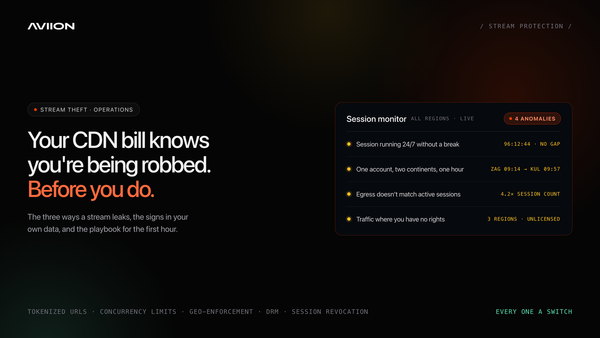
If you read our stream theft post, you already know why this matters: the signs of a leak, sessions that never sleep, egress that doesn't match your audience, traffic in countries where you have no customers, are exactly the anomalies these systems catch on day one instead of at the end of the billing cycle. The same goes for quality regressions after an encoder change or a CDN having a quiet regional problem.
Buy or build: generic anomaly detection comes with most observability platforms. Making it streaming-aware, so it understands that a concurrency spike during a match is normal and the same spike at 4 a.m. on one account is not, takes tuning on your own data. Budget for the tuning, not the tool.
4. FAST schedules from viewership data
The newest one. A playout channel is a schedule, and a schedule is an optimization problem: what to air, when, in what blocks, to hold the audience you have and grow the one you want. Viewership data knows the answer better than intuition does. An agent can draft next week's schedule, build the marathon around what people actually finish, and place the premieres where attention already is.
Buy or build: mostly build, or wait; off-the-shelf options are early. And keep the word draft. A channel is a point of view, and the curation era of FAST rewards channels that feel programmed by someone. Let the machine optimize the schedule. Don't let it become the programmer.
Where the limits are
This is the part vendors skip, so we won't.
Metadata errors compound silently. A wrong genre tag puts a title on the wrong shelf, where nobody watches it, which the recommendation system reads as proof nobody wants it. One bad tag becomes a dead title. Keep human review on the content that matters most, and spot-audit the rest.
QC confidence is not QC coverage. Models flag what they were trained to flag. A new artifact type walks straight past them. Machine QC replaces spot-checking; it doesn't replace ever looking.
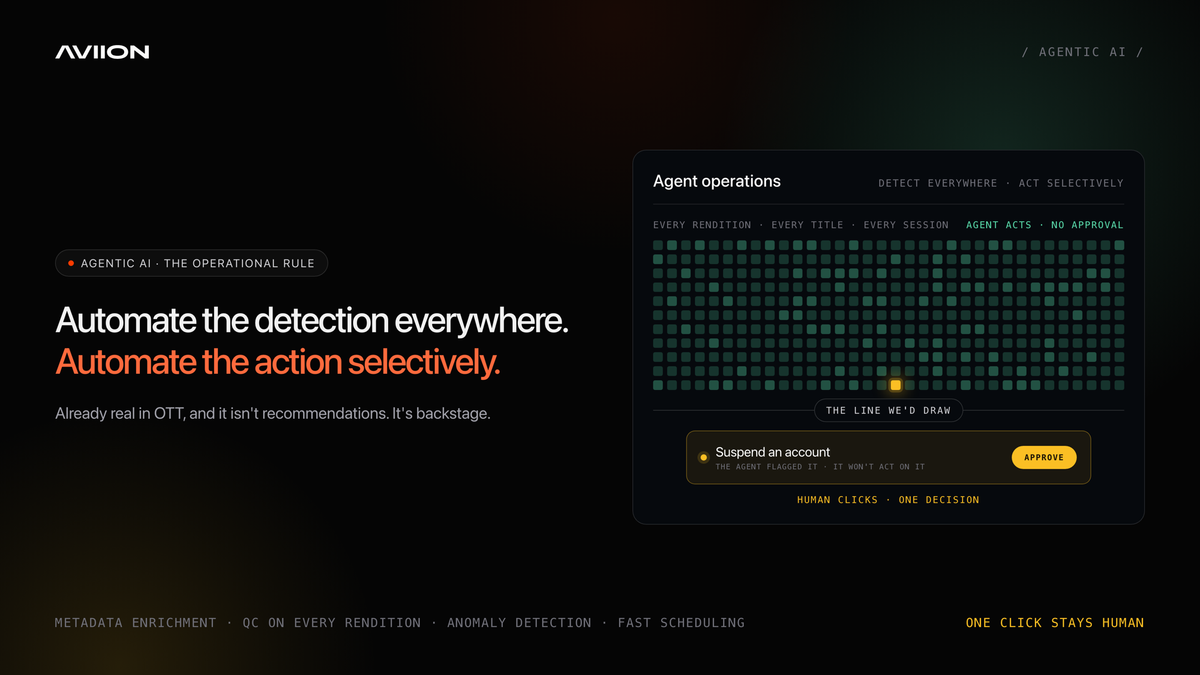
Automate detection everywhere. Automate action selectively. The rule is blast radius: let agents act on their own only where a mistake is cheap and reversible. Re-queueing a transcode, yes. Suspending subscriber accounts, enforcing geo-rights, issuing takedowns, publishing to the front page: detection can be automatic, the action gets a human click. The cost of that click is seconds. The cost of an agent wrongly cutting off a thousand paying customers during a match is a support fire and a refund bill.
Your AI is only as good as your data. Anomaly detection on messy telemetry produces confident nonsense. Schedule optimization on incomplete viewership data optimizes for the audience you can measure, not the one you have. Data hygiene is the unsexy prerequisite for everything above.
The honest conclusion
Agentic AI in OTT is not the robot running the channel. It's the end of humans doing machine work: watching renditions, retyping metadata, staring at dashboards, hand-assembling schedules. The operators who win with it automate the watching and keep the deciding.
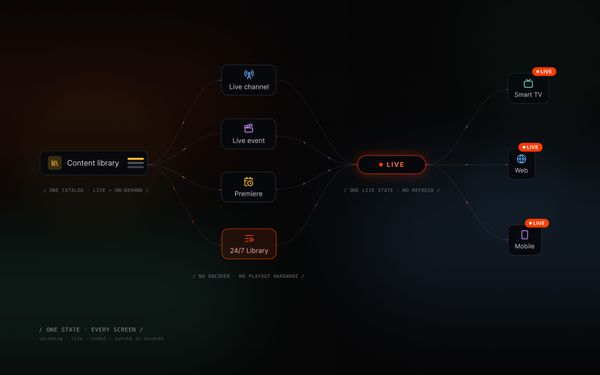
One practical note to end on. Every application above depends on systems that can talk to each other: the agent that re-queues a transcode needs the QC tool and the transcoder in one workflow, and the schedule agent needs the catalogue, the analytics and the playout in one place. If your operation runs on five disconnected tools, the agent has nowhere to stand. That's a platform architecture decision, and it's one of the quieter reasons we build everything into one.