IBC 2026: What Mattered, What Didn't

The board above our sofas read: "See it live. Ask the hard questions." Under it, in smaller type: no sales pitch, just answers, full team on site all four days, case studies with real numbers. We put that up as a promise. Four days later it read less like a slogan and more like the most honest summary of the entire show.
Because the story of IBC 2026 wasn't a new technology. It was an industry that has quietly stopped selling the future and started asking whether the present actually works.
The backdrop didn't hurt the mood. The show drew 41,225 attendees from 170 countries over four days at the RAI, down roughly 6% on last year. Budgets are tighter, travel is scrutinised, and deals take longer to close. That pressure changed the tone on the floor: fewer people shopping for magic, more people shopping for something that survives a Monday.
What mattered
AI stopped being the headline and became the plumbing. "AI" was on almost every banner in all fourteen halls, but in the demos that actually landed, nobody led with it. The vendors who have genuinely absorbed it treat it the way you treat electricity: assumed, not announced. The most telling framing we heard, from a live-delivery vendor, was that AI has moved out of experimentation and into operational reality, with the post-pandemic trials hardened into real workflows.
For operators, the consequence is simple. If everyone has AI, AI is no longer a differentiator, and the useful question shifts from "do you have AI?" to "what does it do to my cost per stream and my time-to-publish?" Expect "AI-first" marketing to fade over the next twelve months while the credible players talk outcomes. AI becomes the how, not the what.
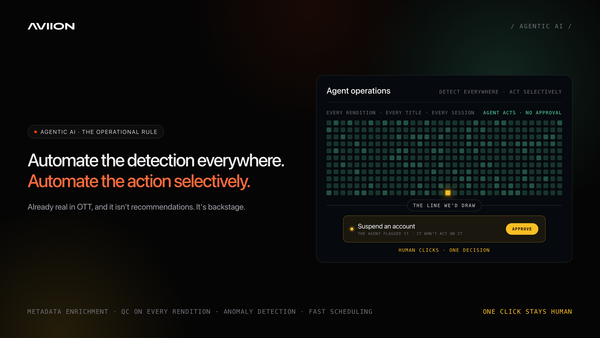
Agentic AI quietly walked into the workflow. The genuinely new thing on the floor wasn't another generative caption tool. It was agents doing multi-step work end to end. One asset-management platform showed agents chaining brand-compliance checks, ad-break detection, QC, clip generation and rights lookups. Another demoed a system that spots newsworthy moments in a live feed and auto-packages clips for social. The pattern across OTT was consistent: AI moving from individual features toward whole operational workflows, with a human kept in the loop for the sensitive steps, publishing, payments, anything customer-facing.
This is where labour genuinely comes out of the chain: not a clever thumbnail, but a sequence of tasks that used to need three people. We wrote about exactly this before the show, including where we'd draw the line on autonomy, and the floor confirmed it. In the next year, agentic layers move off the demo stages and into procurement questions: which parts of my chain can run unattended, and exactly where does the human stay?
The fundamentals came back into the room. The loudest quiet theme was simplification. Operators are drowning in fragmented stacks: multiple vendors, clouds, networks and devices, where every new capability that improves the viewer experience can make the underlying service harder to run. One operator-focused vendor put it well: the real fight isn't Netflix versus Disney+, it's discovery, and the winners solve it rather than launching yet another app. Another built its whole message around keeping a live feed on air when the network degrades: fewer points of failure, automatic recovery.
"Does it just work, and can one team run it?" now beats novelty on the buying sheet. Expect the next twelve months of purchasing to look less like feature-shopping and more like an integration decision: consolidation, unified control, and a hard look at operational load.
What didn't
"AI-powered" as a sticker. When AI is the biggest word on the banner and there is nothing specific behind it, that's the tell. The loudest AI messaging often came from the stands with the least else to say. The market has moved fast enough that shouting about AI now signals you're lost in the trend, not ahead of it.
Invented innovation. In the absence of real breakthroughs, a lot of "innovation" was manufactured to look different: differentiation for its own sake, feature after feature engineered to stand out from the stand next door, solving problems no operator in the aisle actually has. Buyers noticed. You could watch eyes glaze at the fifth variation of the same idea.
Booth theatre. Stands split into two failure modes: frozen in 2005, or so aggressively futuristic they forgot a human has to sit down and get a straight answer. Both are expensive ways to avoid a conversation. Neither builds trust, and trust, this year, was the currency.
What surprised us
How often people asked for the basics. Not "show me your model," but "how long is onboarding?", "what's the actual price?", and "who picks up the phone when it breaks at 22:00 on a match night?" After years of the industry training everyone to expect the spectacular, a striking number of serious buyers walked up looking for something boringly, reliably dependable.
And then came the part we enjoyed most. Whatever a visitor asked us to pull up in the system, it looked almost unreasonably simple: fast, intuitive, obvious. And it all worked. No "that module isn't in this build," no dancing around the awkward question. You could see the shift on people's faces, from "nice product" to a quiet confidence that whatever they threw at us, we could handle it on the spot. That's the surprise, and the opportunity: speed, efficiency, transparency, honesty. People came to Amsterdam looking for a vendor they can trust, and were visibly relieved to find one willing to just answer the question.
The close
We're taking the lesson literally. Aviion is doubling down on the unglamorous things: speed, transparent pricing, demos with real numbers, and being a team you can actually reach when it matters. Our stand, which to our genuine surprise drew a steady stream of compliments, was built on exactly that idea: sit down, ask the hard question, get a straight answer, no pitch.
If we missed you in the halls, the offer still stands.
https://aviion.tv/get-started